![ReedHackersTokyo [Measure Cane Density of Reeds]](https://reedhackerstokyo.com/wp-content/uploads/2024/12/newlogotest700x120-6.png)
-
Is higher or lower density better?
-
The preferred density range varies by player. While professional players generally tend to prefer higher density cane compared to amateur players, some professionals achieve excellent results with relatively lower density cane.
-
How does density affect reed performance?
-
Many players notice that density significantly influences tone color and response. Some players also report that density affects how the reed feels during the scraping process.
-
Why measure density?
-
Using canes with suitable density significantly improves reed-making success rates and eliminates wasted time. Moreover, working with canes of consistent density produces more uniform reeds, and many players find this helps stabilize their playing technique especially embouchure by reducing reed-to-reed variations.
-
Is there a correlation between hardness and density?
-
Based on Reed Hackers Tokyo's single regression analysis of hardness and density measurements, the correlation coefficient (R) was approximately -0.2, with a coefficient of determination (R²) of about 0.04.
This indicates a very weak correlation between hardness and density, showing that hardness measurements can only predict density with about 4% accuracy.
-
Is there a correlation between pre-gauged cane density and post-gauging density?
-
For oboe canes, we conducted a special measurement method on gauged canes and performed single regression analysis against pre-gauging measurements. The results showed a correlation coefficient (R) of approximately 0.95 and a coefficient of determination (R²) of about 0.9. This indicates an extremely strong correlation, demonstrating that post-gauging density can be predicted with high accuracy from pre-gauging density measurements.
Therefore, for oboe canes, we recommend measuring after pre-gauging to save time on the gauging process. While slightly less precise, measurements taken after splitting (before pre-gauging) are also sufficiently practical. For other reed instruments, we recommend measuring after pre-gauging as thick-walled canes can lead to increased measurement error.
-
Can I measure gauged oboe cane?
-
We do not support measurements of gauged oboe cane. To be precise, while CDM-22 can measure it in some cases, it is not practical.
We considered developing a kit for practical measurement, but it would require complex measuring methods and cost approximately 150,000 yen, which we deemed impractical.
-
What are the benefits of measuring both hardness and density?
-
The development of CDM-22 began with the motivation to identify canes that fall within the appropriate hardness range but are still unusable.
The combination of density and hardness data enables more precise cane selection. Furthermore, it provides options such as trying canes with slightly lower hardness but higher density, rather than discarding them.
-
Why measure water temperature? Is it essential?
-
Water temperature affects density calculations. For comparing measurements between summer and winter, we recommend measuring water temperature.
If you're only selecting high-density canes from your current stock, water temperature is less critical - you can enter any standard value.
However, since the companion app enables long-term measurement analysis, measuring water temperature is recommended.
-
What analysis features are available in the companion app?
-
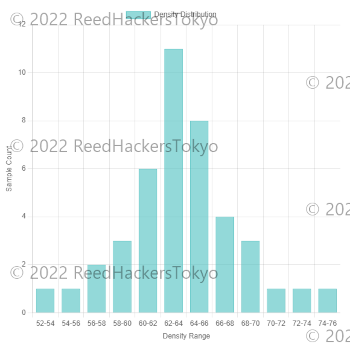
Cane characteristics vary by brand (cane farm) and harvest year. The purpose of this analysis is to help you find brands that suit you. The current version displays density data in graph form (histogram) for your selected brand. If hardness measurements have been entered, these will also be shown in graph form. The graphs show the distribution of cane data, allowing you to determine if a brand's characteristics match your needs. The histogram below shows a sample density distribution from a specific manufacturer and year. Density values on the x-axis are grouped in 2-unit intervals, with the y-axis showing the number of canes in each range. The distribution centers around 62-64, with most canes falling between 60-66, making these canes suitable for players who prefer lower 60s density but less ideal for those preferring values around 70.
For instruments other than oboe, you can analyze variations in gauging thickness by including thickness specifications in the cane type field.
You can also create graphs by filtering data based on finished reed ratings alone, or by combining both cane brand and rating criteria for analysis.
-
What can we learn from the 3D analysis service?
-
The first thing 3D measurements reveal is the 'difference from your perception.' You can discover differences between your intended shape and actual results, as well as any unexpected asymmetry. Furthermore, by measuring multiple reeds, you can identify your tendencies or habits. So far, common issues found include habits related to dominant hand use, knife movement patterns, and asymmetry caused by lighting position.
Another application is verifying the accuracy of profiler templates by measuring them.